On 19 June 2026, the Government promulgated Decree No. 217/2026/NĐ-CP detailing a number of articles of the Construction Law regarding the management of construction activities. One of the key highlights of the Decree is the specific regulation on the application of Building Information Modeling (BIM) in construction activities and digital technology solutions, thereby establishing an important legal framework to accelerate digital transformation in the construction sector.
Mandatory Application of BIM for New Construction Works from Grade II and Above
According to the Decree, all newly constructed works classified as Grade II and above are required to apply BIM from the stage of preparing the Feasibility Study Report or the Economic–Technical Report. This marks a significant shift from the traditional project management approach based on paper documents and drawings to a digital management approach based on digital data and information models throughout the entire lifecycle of the construction works.
For linear infrastructure projects, projects located in areas with special characteristics, or projects involving state secrets, the investment decision-maker may decide not to apply BIM in order to ensure feasibility and suitability with the actual implementation conditions of the project.
Establishing Regulations on BIM Data and Standardizing Information Exchange
The Decree clearly defines BIM data as a digital asset that is created, managed and utilized throughout the implementation process of a construction investment project. For construction works subject to mandatory BIM application, during the appraisal procedures, investors and project preparation agencies are responsible for submitting BIM data to the competent construction authorities.
BIM data must be submitted in open standard formats such as IFC (Industry Foundation Classes) or other open formats suitable for the characteristics of the construction works. Where necessary, competent authorities may request the submission of the original data format for verification, ensuring the authenticity of the model, including all parameters, object structures and attributes. BIM models submitted for state management purposes must present the location, three-dimensional geometry of the construction works, the principal dimensions of major components, and the solutions for connection with internal and external technical infrastructure systems.
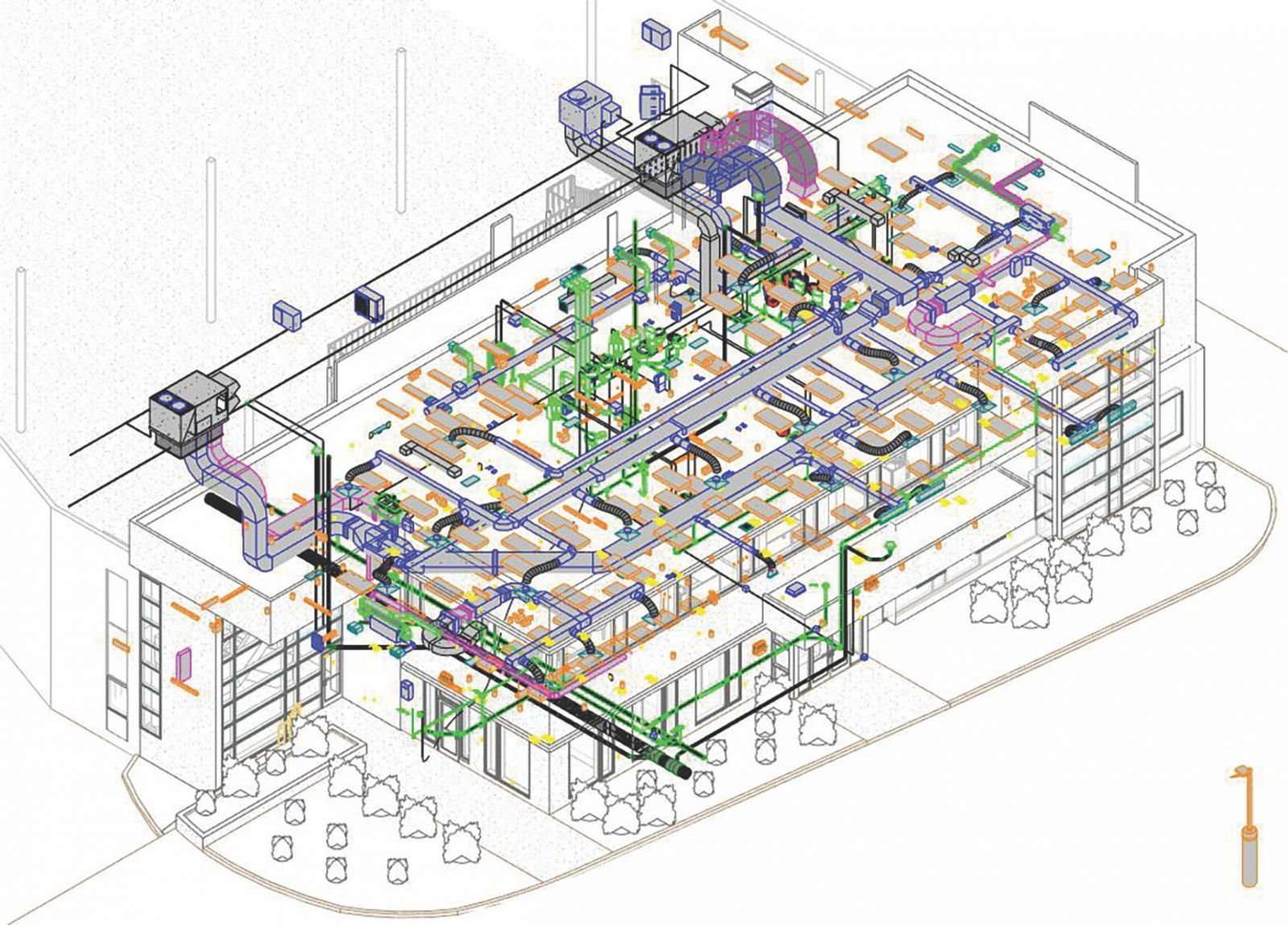 BIM Model
Common Data Environment (CDE) – A Foundation for Digital Project Management
A notable point of the Decree is the requirement to establish a Common Data Environment (CDE) for Grade I and higher construction works under public investment projects applying BIM. Investors are responsible for establishing, managing and operating the CDE to store, share, control and manage project information and data.
BIM models that have been approved by the investor and issued through the CDE shall serve as the official basis for project participants to compare, review and clarify technical issues. For other categories of construction works, the Decree encourages investors to proactively implement CDE to improve coordination efficiency and information management throughout the project implementation process.
Paving the Way for Replacing Paper-Based Documentation with Digital Models
Another groundbreaking provision of the Decree is the gradual adoption of BIM models in state management of construction activities. Ministries managing specialized construction works and provincial People’s Committees are responsible for developing roadmaps for transitioning to BIM-based management in accordance with actual conditions, organizational capacity and technological infrastructure.
Once state management authorities satisfy the necessary requirements regarding technical infrastructure, human resources and technological systems, BIM models may replace paper-based design documents and possess equivalent legal validity. In such cases, investors are not required to submit paper design documents for information that has been fully and accurately represented in the BIM model.
Construction authorities are also allowed to use BIM data during appraisal and acceptance inspection activities, including the review of the construction geometry, architectural solutions, structural systems, technical systems, compliance with technical regulations and applicable standards, detection of technical conflicts, and extraction of key indicators for management purposes.
Creating a “Digital Record” of Construction Works Throughout Their Lifecycle
According to the Decree, upon completion of a construction work, the investor is responsible for updating the standardized as-built BIM model into the National Database on Construction Activities and handing over the complete BIM data to the operation, management and maintenance entity for use in operation and maintenance activities.
This regulation ensures the continuity of construction data from the stages of project preparation, surveying, design and construction through operation and maintenance, gradually establishing a comprehensive “digital record” of the construction work throughout its entire lifecycle.
Promoting a Digital Ecosystem in the Construction Industry
In addition to providing detailed regulations on BIM, the Decree also emphasizes that the management, exploitation, sharing and storage of BIM data within the CDE must comply with legal regulations on information security, data protection, archiving and intellectual property. The rights and responsibilities of relevant parties regarding BIM data shall be determined in contracts and in accordance with applicable laws.
The Decree assigns the Ministry of Construction to issue general guidance on the application of BIM in construction activities. Where necessary, ministries managing specialized construction works may issue detailed guidance on BIM implementation for different project phases under their respective sectors, provided that such guidance complies with the general BIM application guidance issued by the Ministry of Construction./.
Editorial_TECCO1