At the invitation of MSI Global Private Limited (MSI) – a company wholly owned by the Singapore Land Transport Authority (LTA), a delegation from Construction Investment Consulting Joint Stock Company 1 (TECCO1), led by Mr. Nguyen Trong Nghia – Technology Director, together with Mr. Ngo Xuan Hung (Locomotive and Rolling Stock expert), Mr. Phan Trung Lam (IT and AFC system expert), and Mr. Nguyen Chi Sang (Chairman of the Vietnam Association of Mechanical Engineers – VAMI), visited and worked with their partner in Singapore to study testing, evaluation, and safety certification models for urban railway systems.
As part of the working program, the delegation visited and worked at the Singapore Rail Test Centre (SRTC) of the Singapore Land Transport Authority. Representatives of MSI – the operating entity – stated that SRTC performs technical verification tasks before trains and related systems are put into operation on the Mass Rapid Transit (MRT) network. Testing activities are organized following an integrated system approach: from locomotives and rolling stock, signaling, communications, power supply to electromagnetic compatibility (EMC/EMF), along with simulation of real operating conditions. This approach enables a comprehensive assessment of the system’s operational readiness, rather than testing individual pieces of equipment separately.
MSI representatives also shared how SRTC applies the RAMS (Reliability, Availability, Maintainability, Safety) framework throughout the testing and evaluation process, with close reference to European RAMS standards for railways, including: EN 50126 – the fundamental RAMS standard, specifying the system lifecycle from design, manufacturing, installation, operation to maintenance for railway systems; EN 50716 – the standard applicable to control software, signaling and railway safety-related programmable systems; EN 50129 – the standard for safety approval of railway signaling systems.
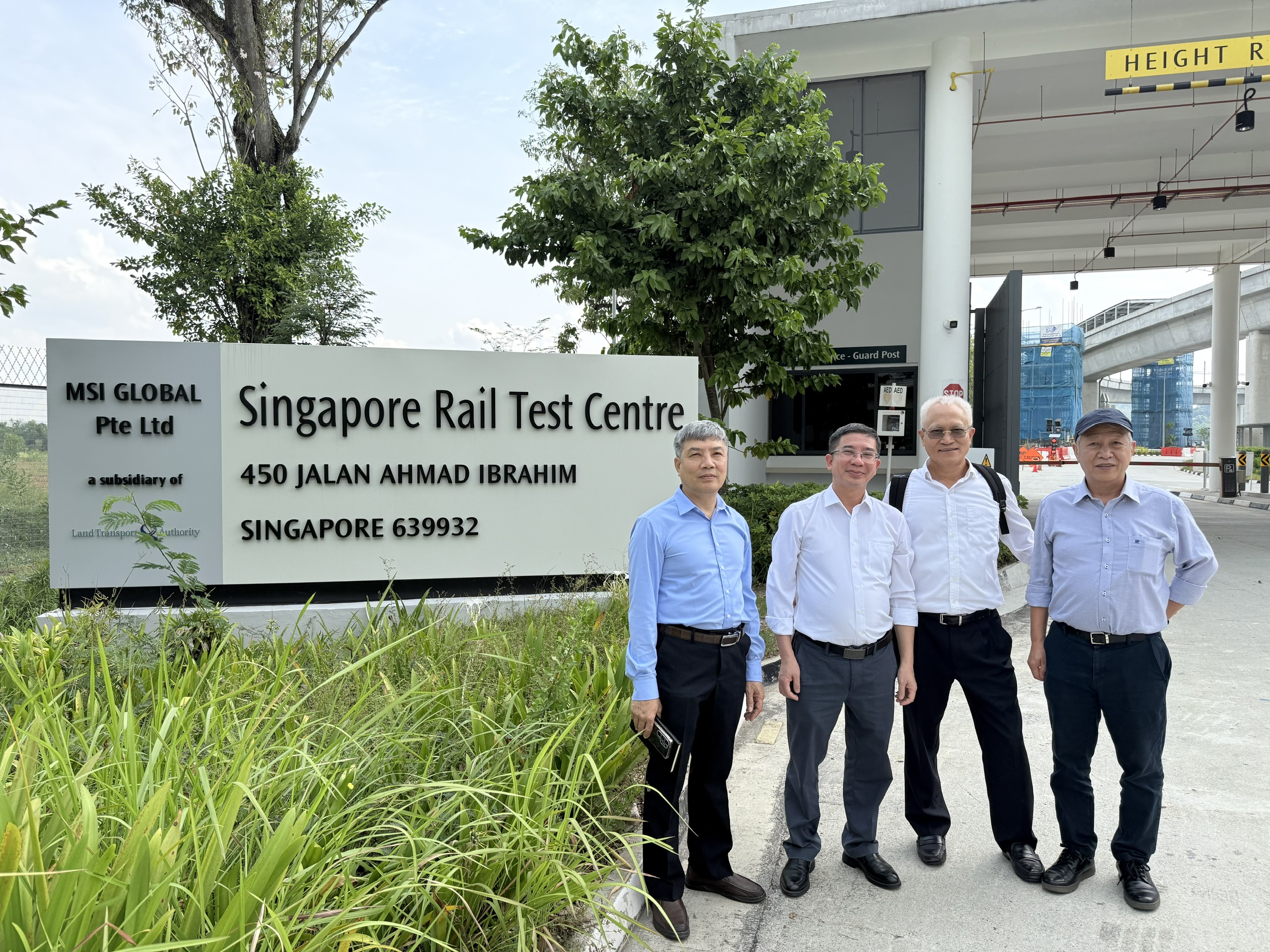
TECCO1 delegation working at SRTC
These standards are integrated into SRTC’s testing scenarios to assess the interoperability and synchronization between trains and infrastructure prior to commercial operation. This is also a key set of standards for railway and urban railway projects.
Through this experience-sharing mission, the TECCO1 delegation recognized the important role of a national-level testing center in supporting regulatory authorities in independently controlling technical quality, while also creating an environment for equipment suppliers to refine their products in line with real operational requirements, thereby providing significant support to the railway industry in the localization process.
The trip also provided TECCO1 with practical insights into how Singapore systematically organizes railway safety testing and certification, with a strong linkage between technical standards and operational conditions.
Editorial Board _TECCO1